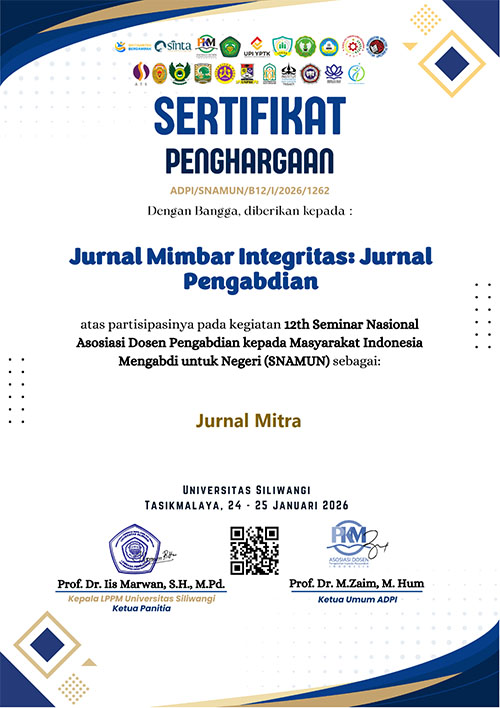
Enhancing Management Students’ Competencies through Digital Learning Innovation: The Use of Artificial Intelligence and Canva
Abstract
The rapid development of digital technology, particularly Artificial Intelligence (AI), requires students to possess adequate digital literacy competencies in the learning process. However, its utilization remains largely technical and has not been optimally integrated to enhance academic quality. This community service activity aims to improve the competencies of Management students through digital learning innovation by utilizing AI and Canva in developing academic presentation materials. The activity was implemented through training and mentoring in the form of a mini workshop, which included the introduction of AI, effective prompt construction, and hands-on practice in creating presentation materials using Canva. The program was conducted with undergraduate Management students and evaluated using questionnaires to assess participants’ understanding, skills, and satisfaction. The results indicate a significant improvement in students’ ability to systematically develop academic content using AI, as well as increased creativity in designing presentations through Canva. In addition, students demonstrated a better understanding of the ethical and responsible use of AI in academic contexts.This activity implies that the integration of AI and digital design tools can enhance learning quality, foster creativity, and strengthen students’ digital competencies. Therefore, the use of AI and Canva as digital learning innovations is effective in improving students’ academic competencies and digital literacy, while also preparing them to face the challenges of learning in the digital transformation era.
Downloads
References
- Akbar, P. I. M. (2023). Pengaruh Literasi Digital Terhadap Proses Pembelajaran Mahasiswa Dalam Era Revolusi Industri 4.0. Jurnal MEKOM (Media Komunikasi Pendidikan Kejuruan), 12(1 SE-Articles), 24–29. https://doi.org/10.26858/mkpk.v12i1.6890
- Bećirović, S., Polz, E., & Tinkel, I. (2025). Exploring students’ AI literacy and its effects on their AI output quality, self-efficacy, and academic performance. Smart Learning Environments, 12(1), 29. https://doi.org/10.1186/s40561-025-00384-3
- Chan, A., & Sung, C. (2025). Enhancing students’ digital literacy skills through their technology use in a course-based research project: a Hong Kong case study. Asia Pacific Education Review. https://doi.org/10.1007/s12564-025-10038-1
- Cotton, D. R. E., Cotton, P. A., & Shipway, J. R. (2024). Chatting and cheating: Ensuring academic integrity in the era of ChatGPT. Innovations in Education and Teaching International, 61(2), 228–239. https://doi.org/10.1080/14703297.2023.2190148
- Dwivedi, Y. K., Kshetri, N., Hughes, L., Slade, E. L., Jeyaraj, A., Kar, A. K., Baabdullah, A. M., Koohang, A., Raghavan, V., Ahuja, M., Albanna, H., Albashrawi, M. A., Al-Busaidi, A. S., Balakrishnan, J., Barlette, Y., Basu, S., Bose, I., Brooks, L., Buhalis, D., … Wright, R. (2023). Opinion Paper: “So what if ChatGPT wrote it?” Multidisciplinary perspectives on opportunities, challenges and implications of generative conversational AI for research, practice and policy. International Journal of Information Management, 71, 102642. https://doi.org/https://doi.org/10.1016/j.ijinfomgt.2023.102642
- Getenet, S., Cantle, R., Redmond, P., & Albion, P. (2024). Students’ digital technology attitude, literacy and self-efficacy and their effect on online learning engagement. International Journal of Educational Technology in Higher Education, 21(1), 3. https://doi.org/10.1186/s41239-023-00437-y
- Kasneci, E., Sessler, K., Küchemann, S., Bannert, M., Dementieva, D., Fischer, F., Gasser, U., Groh, G., Günnemann, S., Hüllermeier, E., Krusche, S., Kutyniok, G., Michaeli, T., Nerdel, C., Pfeffer, J., Poquet, O., Sailer, M., Schmidt, A., Seidel, T., … Kasneci, G. (2023). ChatGPT for good? On opportunities and challenges of large language models for education. Learning and Individual Differences, 103, 102274. https://doi.org/https://doi.org/10.1016/j.lindif.2023.102274
- Malinda, S., Febrianti, R., Yuliani, Y., Shafira Vanessa, A., Efriani, B., & Nettiary Kelara, B. (2025). Integrating Rationality and Religiosity In Financial Literacy Education: Strengthening Investment Awareness And Preventing Illegal Online Lending At Tahfiz Al-Qur’an Izzudin Islamic Boarding School. International Journal Of Community Service, 5(4), 486–492. https://doi.org/10.51601/ijcs.v5i4.937
- Presiden Republik Indonesia. (2005). Undang-Undang (UU) tentang guru dan dosen nomor 14. Dewan Perwakilan Rakyat Indonesia, 2.
- Presiden Republik Indonesia. (2023). Undang-Undang Republik Indonesia Nomor 20 Tahun 2023 Tentang Aparatur Sipil Negara. 202875, 1–44. https://peraturan.bpk.go.id/Details/269470/uu-no-20-tahun-2023
- Thamrin, K. M. H., Febrianti, R., Mardyaningsih, W., & Andriana, I. (2026). Youth Financial Literacy : Pathway to Independence for SMA Bina Jaya Students. Komunita Jurnal Pengabdian Dan Pemberdayaan Masyarakat, 5(1), 270–277. https://doi.org/10.60004/komunita.v5i1.398
- Wati, I., Ernita, M., Ristiliana, & Lubis, I. (2023). Pengaruh Literasi Digital Dan Minat Baca Terhadap Motivasi Belajar Generasi Z. Fakultas Keguruan Dan Ilmu Pendidikan, Universitas Lampung. Pendidikan Ekonomi Dan Kewirausahaaan, 6(1), 21–33.
- Zawacki-Richter, O., Marín, V. I., Bond, M., & Gouverneur, F. (2019). Systematic review of research on artificial intelligence applications in higher education – where are the educators? International Journal of Educational Technology in Higher Education, 16(1), 39. https://doi.org/10.1186/s41239-019-0171-0

This work is licensed under a Creative Commons Attribution-NonCommercial-ShareAlike 4.0 International License.
Pemberitahuan Hak Cipta:
Seluruh karya yang dipublikasikan pada jurnal MIMBAR INTEGRITAS dilindungi oleh hak cipta dan didistribusikan di bawah lisensi Creative Commons Attribution-ShareAlike 4.0 International (CC BY-SA 4.0). Lisensi ini memberikan kebebasan kepada pengguna untuk menyalin, membagikan, menampilkan, mengadaptasi, dan mengembangkan karya dalam bentuk apa pun, termasuk untuk tujuan komersial, dengan ketentuan:
- Pengguna wajib mencantumkan kredit yang sesuai kepada penulis dan sumber asli publikasi.
- Pengguna harus menyertakan tautan atau informasi mengenai lisensi CC BY-SA 4.0.
- Apabila karya diubah, diadaptasi, atau dikembangkan, maka hasil karya turunan wajib didistribusikan menggunakan lisensi yang sama.
- Penggunaan karya tidak boleh menghilangkan hak moral penulis sebagai pemilik karya asli.
Dengan lisensi ini, publikasi dapat diakses dan dimanfaatkan secara luas untuk kepentingan akademik, penelitian, pendidikan, dan pengembangan ilmu pengetahuan dengan tetap menghormati hak cipta penulis.